Independence Day
×
1 / 1
❮
❯
Independence Day, observed annually on 14 August, is a national holiday in Pakistan. It commemorates the day when Pakistan achieved independence from the United Kingdom and was declared a sovereign state following the termination of the British Raj between the 14th and 15th August 1947. By the time of independence, Pakistan retained King George VI and after 1952, Queen Elizabeth II as head of state until its transition into a republic in 1956. The nation came into existence as a result of the Pakistan Movement, which aimed for the creation of an independent Muslim state in the north-western regions of British India via partition.
The movement was led by the All-India Muslim League under the leadership of Quaid-e-Azam Muhammad Ali Jinnah. The event was brought forth by the Indian Independence Act 1947 under which the British Raj gave independence to the Dominion of Pakistan which comprised West Pakistan (present-day Pakistan) and East Pakistan (now Bangladesh). That year the day of independence coincided with 27 Ramadan of the Islamic calendar, the eve of which, one of the five nights on which Laylat al-Qadr may occur, is regarded as sacred by Muslims.
The main Independence Day ceremony takes place in Islamabad, where the national flag is hoisted at the Presidential and Parliament buildings. It is followed by the national anthem and live televised speeches by leaders. Usual celebratory events and festivities for the day include flag-raising ceremonies, parades, cultural events, and the playing of patriotic songs. A number of award ceremonies are often held on this day, and Pakistanis hoist the national flag atop their homes or display it prominently on their vehicles and attire.
Independence;
In 1946, the Labour government in Britain, exhausted by recent events such as World War II and numerous riots, realized that it had neither the mandate at home, the support internationally, nor the reliability of the British Indian Army for continuing to control an increasingly restless British India. The reliability of the native forces for continuing their control over an increasingly rebellious India diminished, and so the government decided to end the British rule of the Indian Subcontinent.
In 1946, the Indian National Congress, being a secular party, demanded a single state. The All India Muslim League, who disagreed with the idea of single state, stressed the idea of a separate Pakistan as an alternative. The 1946 Cabinet Mission to India was sent to try to reach a compromise between Congress and the Muslim League, proposing a decentralized state with much power given to local governments, but it was rejected by both of the parties and resulted in a number of riots in South Asia.
Eventually, in February 1947, Prime Minister Clement Attlee announced that the British government would grant full self-governance to British India by June 1948 at the latest. On 3 June 1947, the British government announced that the principle of division of British India into two independent states was accepted. The successor governments would be given dominion status and would have an implicit right to secede from the British Commonwealth. Viceroy Mountbatten chose 15 August, the second anniversary of Japan's surrender in the World War II, as the date of power transfer. He chose 14 August as the date of the ceremony of power transfer to Pakistan because he wanted to attend the ceremonies in both India and Pakistan.
The Indian Independence Act 1947 passed by the Parliament of the United Kingdom divided British India into the two new independent dominions; the Dominion of India (later to become the Republic of India) and the Dominion of Pakistan (later to become the Islamic Republic of Pakistan). The act provided a mechanism for division of the Bengal and Punjab provinces between the two nations (see partition of India), establishment of the office of the Governor-General, conferral of complete legislative authority upon the respective Constituent Assemblies, and division of joint property between the two new countries. The act later received royal assent on 18 July 1947. The partition was accompanied by violent riots and mass casualties, and the displacement of nearly 15 million people due to religious violence across the subcontinent; millions of Muslim, Sikh and Hindu refugees trekked the newly drawn borders to Pakistan and India respectively in the months surrounding independence.
On 14 August 1947, the new Dominion of Pakistan became independent and Quaid-e-Azam Muhammad Ali Jinnah was sworn in as its first governor general in Karachi. Independence was marked with widespread celebration, but the atmosphere remained heated given the communal riots prevalent during independence in 1947.
The date of independence;
Since the transfer of power took place on the midnight of 14 and 15 August, the Indian Independence Act 1947 recognized 15 August as the birthday of both Pakistan and India. The act states; "As from the fifteenth day of August, nineteen hundred and forty-seven, two independent Dominions shall be set up in India, to be known respectively as India and Pakistan."
"August 15 is the birthday of the independent and sovereign state of Pakistan. It marks the fulfillment of the destiny of the Muslim nation which made great sacrifices in the past few years to have its homeland."
The first commemorative postage stamps of the country, released in July 1948, also gave 15 August 1947 as the independence day, however in subsequent years 14 August was adopted as the independence day. This is because Mountbatten administered the independence oath to Jinnah on the 14th, before leaving for India where the oath was scheduled on the midnight of the 15th. The night of 14–15 August 1947 coincided with 27 Ramadan 1366 of the Islamic calendar, which Muslims regard as a sacred night.
The independence day is one of the six public holidays observed in Pakistan and is celebrated all across the country. To prepare and finalise the plans for independence day celebrations, meetings are held in the provincial capitals by local governments which are attended by government officials, diplomats, and politicians. Public organisations, educational institutions, and government departments organise seminars, sports competitions, and social and cultural activities leading up to the independence day. In Karachi, drives are initiated to clean and prepare the Mazar-e-Quaid (Jinnah Mausoleum) for the celebration.
The official festivities take place in Islamabad and commence with the raising of the national flag on the Parliament House and the Presidency followed by a 31-gun salute in the capital and a 21-gun salute in provincial capitals. The President and Prime Minister of Pakistan address the nation in live telecasts. Government officials, political leaders and celebrities deliver messages or speeches during rallies, ceremonies and events, highlighting Pakistani achievements, goals set for the future, and praise the sacrifices and efforts of national heroes. Government buildings including the Parliament House, Supreme Court, President House and Prime Minister's Secretariat are decorated and illuminated with lights and bright colours. A change of guard takes place at national monuments by the Armed Forces. The Army, Air Force and Navy feature prominently in independence day parades. In the cities around the country, the flag hoisting ceremony is carried out by the nazim (mayor) belonging to the respective constituency, and in various public and private departments, the ceremony is conducted by a senior officer of that organisation. In 2017, the Pakistan International Airlines introduced a special in-flight jam session to entertain passengers traveling on Independence Day, featuring artists singing national songs on board a domestic flight.
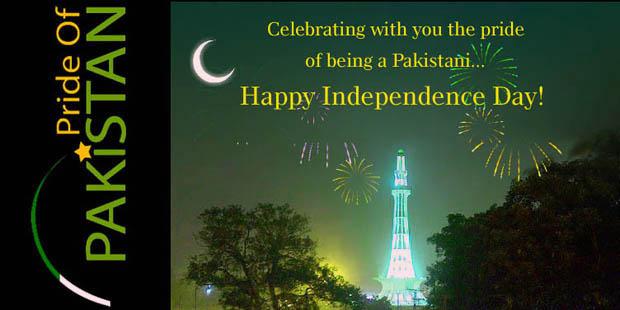
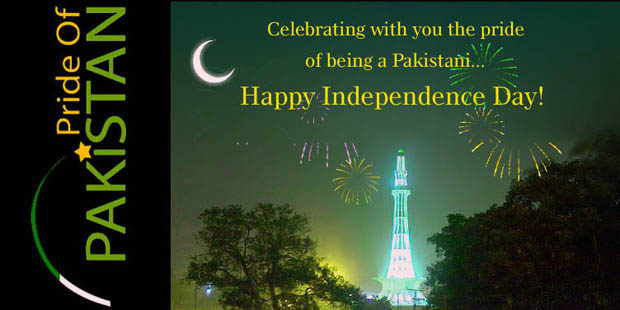
International figures including heads of state, public personalities and diplomats extend their messages of felicitation to Pakistan, and flag raising ceremonies are held across Pakistani diplomatic missions abroad. Overseas dignitaries are invited as chief guests in ceremonies, while their military contingents often participate in parades. On the international border, Pakistani paramilitary troops exchange sweets with their cross-border counterparts as a tradition. National flags are displayed on major roads and avenues such as Shahrah-e-Faisal, Shahara-e-Quaideen, and Mazar-e-Quaid Road, leading up to Jinnah's mausoleum in Karachi. The Minar-e-Pakistan in Lahore, where the Pakistan Resolution was passed in 1940, is fully illuminated on the eve of the independence day to signify its importance in the creation of Pakistan.
Public celebrations;
As the month of August begins, special stalls, fun fairs and shops are set up across the country for the sale of national flags, buntings, banners and posters, badges, pictures of national heroes, multimedia and other celebratory items. Vehicles, private buildings, homes, and streets are decorated with national flags, candles, oil lamps, pennants and buntings. Businesses engage in rigorous marketing, as do leading designer fashion outlets which stock independence-themed clothing, jewellery and self-adornments.
The day begins with special prayers for the integrity, solidarity, and development of Pakistan in mosques and religious places across the country. Citizens attending independence day parades and other events are usually dressed in Pakistan's official colours, green and white. Many people meet their friends and relatives, dine over Pakistani food, and visit recreational spots to mark the holiday. Public functions including elaborate firework shows, street parades, seminars, televised transmissions, music and poetry contests, children's shows and art exhibitions are a common part of the celebrations. Along with flag hoisting, the national anthem is sung at various government places, schools, residences, and monuments on the day, and patriotic slogans such as Pakistan Zindabad are raised. Musical concerts and dance performances are arranged both inside and outside the country, featuring popular artists. Homage is paid to the people who lost their lives during the migration and riots which followed independence in 1947, as well as martyrs of the Pakistan Army and recipients of Nishan-e-Haider, and political figures, famous artists and scientists.
Immigrant communities in Pakistan partake in the festivities as well. In countries where there are significant Pakistani communities or which share strong relations with Pakistan, the national colours and flag of Pakistan are frequently illuminated on prominent structures, squares and public monuments as a show of celebration. The Pakistani diaspora organises cultural events to celebrate independence day, and public parades are held in cities with large Pakistani populations, such as New York, London and Dubai. In addition, some Kashmiris from Indian side of Jammu and Kashmir are known to observe the day, causing friction with Indian authorities.
Security measures;
Security measures in the country are intensified as the independence day approaches, especially in major cities and in troubled areas. The security is set up after various representatives of intelligence and investigation agencies meet. High alert is declared in sensitive areas such as the country's capital, to restrict security threats. Despite this, there have been instances where attacks have occurred on independence day by insurgents who boycott the celebrations as a part of their protest.
On 13 August 2010, the country witnessed floods causing deaths of 1,600 people and affecting 14 million lives. On account of the calamity, the president made an announcement that there would not be any official celebration of the independence day that year.
Since 2011, the Google Pakistan homepage has featured special doodles designed with Pakistani symbols to mark Pakistan's Independence Day. Such symbols have included the star and crescent, national monuments and colours, historic and artistic representations, geographic landscapes and other national symbols. Facebook allows its users in Pakistan to post an independence day status with a Pakistani flag icon on it or greets users in the country with a special message on the home page.